
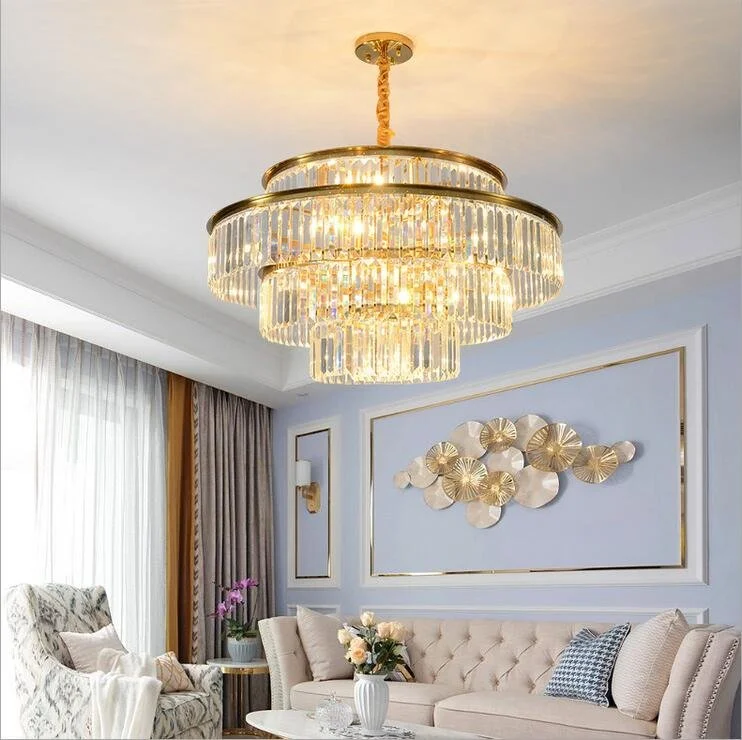
A dining room lives or dies by the light over the table. It is the fixture everyone sits under, eats under and photographs at birthdays, and it is usually the largest single piece in the room. Choosing a modern chandelier for dining room use is therefore less about finding the most dramatic design in a catalogue, and more about matching four things to your own room: the size of the table, the height of the ceiling, the shape of the fixture, and the finish that ties it to everything else. Get those four right and almost any well-made design will look like it was planned with the room. Get one wrong and even an expensive fixture looks like a mistake.
This guide walks through each decision in the order we recommend making it.
Start With the Table, Not the Fixture
In a dining room, the chandelier serves the table, so the table sets the proportions. The most reliable rule is width: the fixture should be about one-half to two-thirds of the width of the table, and noticeably narrower than the table itself, so it never overhangs the place settings. For length on a rectangular table, keep the fixture, or the row of fixtures, to about one-third to one-half of the table length, with at least 6 inches of table edge showing beyond the light on each side.
A worked example helps. A common dining table is 72 inches long and 36 to 40 inches wide. That points to a fixture roughly 20 to 26 inches across for a round design, or a linear design around 30 to 40 inches long. A 36-inch round fixture over that table would crowd the settings and dominate every photograph; a 16-inch fixture would float, lost, in the middle of the ceiling.
If you are between two sizes, choose based on the room around the table. A dining space that opens into a living area can carry the larger size, because the fixture is seen from farther away. A small, enclosed dining room usually rewards the smaller one.
Height: The Rule Everyone Can Check
Hang the bottom of the fixture 30 to 36 inches above the tabletop in a room with an 8-foot ceiling. That range is high enough that sight lines across the table stay open and nobody catches the fixture when standing up, and low enough that the light still feels connected to the table rather than to the ceiling.
Taller ceilings change the maths, not the principle. For each extra foot of ceiling above 8 feet, add roughly 3 inches to the hanging height. A 10-foot ceiling therefore points to about 36 to 42 inches above the table. Whatever your ceiling, the test is seated: sit at the table, look across at where a guest would sit, and confirm you can see their face without the fixture cutting through it.
Adjustability matters here. A design with an adjustable cord or chain lets you fine-tune after the furniture is in place, which is worth more than a fixed drop chosen from a ceiling measurement alone. Our example below is one such design, and that flexibility is a large part of why it suits so many rooms.
Shape: Round, Linear, Drum or Sputnik?
Shape follows table shape first, and room character second. Round fixtures over round tables are the natural pairing, and a round design over a rectangular table works well too, softening the corners of the room. Linear fixtures exist for long rectangular tables: they spread light evenly along the table instead of pooling it in the middle, and they look deliberate where a single round fixture might leave the ends dim.
Drum designs, where a fabric or metal shade surrounds the lights, give the softest, most diffused light and suit rooms used for long, relaxed meals. Open designs, crystal, sputnik and sculptural metal pieces, throw more sparkle and shadow, and become the visual centre of the room. Neither is better; the question is whether you want the fixture to be the event, or to support everything else.
For a concrete reference, the 24-Inch Modern Gold Crystal Chandelier DS-SZ42 is a round, four-tier crystal design at about 24 inches across, with ten E12 sockets and an adjustable hanging cord. On a 36 to 40 inch wide table it sits squarely inside the size rules above, and its layered crystal suits a room that wants one clear focal point. You can compare its proportions with other shapes in our modern chandelier collection.
Finish and Materials: Tie It to the Room
A modern chandelier for dining room spaces does not need to match every metal in sight, but it does need to belong. The simplest approach is to pick up one finish already present in the room: the hardware on a sideboard, the legs of the chairs, the frame of a mirror. Gold and brass tones warm up grey and white rooms and pair naturally with wood tables. Black finishes give contrast in light rooms and definition in open-plan spaces. Chrome and polished nickel feel coolest and crispest, and suit rooms with a lot of glass and stone.
Crystal deserves a specific note, because it crosses styles. In a traditional room it reads as classic; in a plain, modern room the same crystal becomes the one ornate note, and the contrast is often exactly what the room needed. Glass shades sit in the middle, softer than crystal, more decorative than plain metal. If your dining room is also your everyday eating space, consider cleaning as well: open crystal and glass wipe clean more easily than intricate fabric shades near cooking steam.
Bulbs, Brightness and Dimming
Dining light needs range more than raw power. A meal-prep or homework session at the table wants bright, clear light; a long dinner wants a fraction of that. Two choices give you that range. First, count total light, not fixtures: as a rough guide, a dining room needs enough combined bulb output that the table is clearly lit edge to edge, which for most modern LED bulbs means several medium-output bulbs rather than one very bright one. Multi-socket designs spread that light and reduce harsh shadows on faces and food.
Second, put the fixture on a dimmer, and choose bulbs that are stated to be dimmable and compatible with it. Check the socket type before ordering bulbs, E12 and E14 are common on decorative fixtures and are not interchangeable, and choose a warm to neutral colour temperature, around 2700K to 3000K, for light that flatters both food and people. Cooler temperatures belong in workspaces, not over a dinner table.
The Mistakes That Make a Good Fixture Look Wrong
The most common is scale copied from a showroom. A fixture photographed over a 10-foot table in a high-ceilinged room will be far larger than the same-looking design should be over a 6-foot table at home. Measure your table, apply the width rule, and only then look at photographs.
The second is hanging by ceiling height alone, without the seated test. A fixture can satisfy every formula and still cut across faces at your table if the table is higher or lower than standard.
The third is buying the fixture before the table. If both are still to be chosen, choose the table first, or at least fix its size, because the fixture proportions follow from it. Reversing the order is how people end up moving a junction box.
The fourth is forgetting the switch. A beautiful fixture on a single on-off switch, with no dimmer, will be too bright for half its life. Budget for the dimmer as part of the fixture, not as an afterthought.
A Short Checklist Before You Order
One, table length and width written down. Two, fixture width inside the one-half to two-thirds rule. Three, hanging height planned at 30 to 36 inches above the table for an 8-foot ceiling, adjusted upward for taller ceilings, with an adjustable cord if you can get it. Four, shape matched to table shape. Five, finish tied to one finish already in the room. Six, socket type, bulb count and dimmer compatibility confirmed.
Choosing a modern chandelier for dining room use is, in the end, a measuring exercise with an enjoyable ending. Do the measuring first, and the design you fall for will very likely be one that also fits, which is the only combination that still looks right a year later.
Ready to measure your shortlist against your table? Browse the full chandeliers collection and filter by width to match the range you just calculated.