
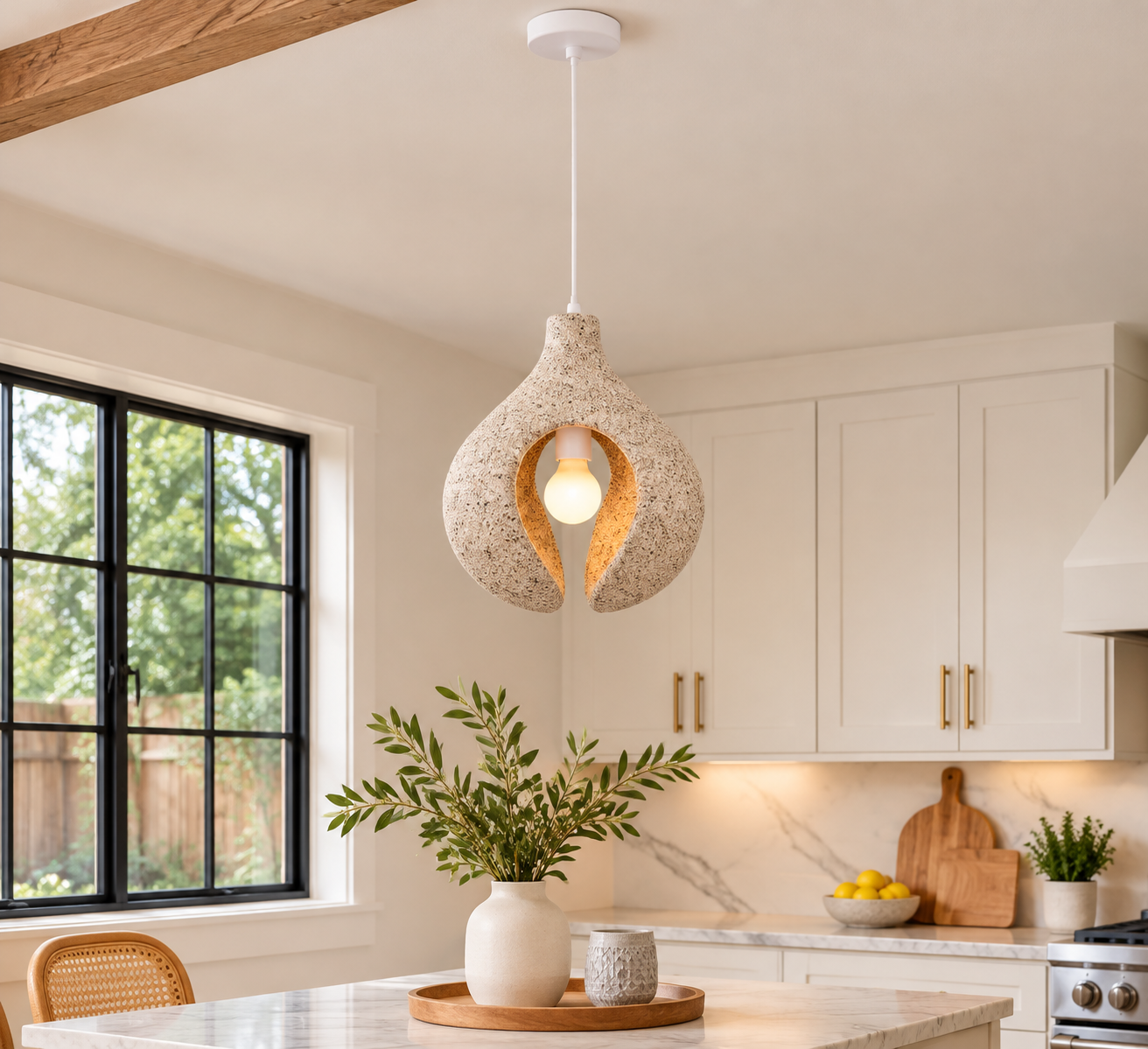
If you are measuring your counter and wondering what size pendant light for kitchen island use actually looks right, you are not alone. Pendant size is the decision homeowners most often guess at, and it is the one that is hardest to change later, because the junction boxes, the cord lengths and the whole visual rhythm of the kitchen depend on it. Choose pendants that are too small and they vanish over a long island, leaving the work surface underlit. Choose them too large and they crowd the sight lines, block the view across the kitchen and make tall family members nervous every time they stand up from a stool.
The good news is that island pendant sizing follows a small set of repeatable rules. Once you know your island length and width, the right diameter range and the right number of pendants usually fall out of two or three simple calculations. This guide walks through them in order, with worked examples for the most common island sizes.
Start With the Island, Not the Catalogue
Every sizing rule starts with the island itself, so measure before you browse. Write down three numbers: the length of the island countertop, its width (depth), and the height of the ceiling above it. If the island has an overhang for seating, include the full countertop in your measurements, because the pendants need to light the whole surface, not just the work zone.
A useful first check on width: a single row of pendants runs down the centre line of the island, and each pendant should be noticeably narrower than the island is deep. For a standard island that is 36 to 42 inches deep, individual pendants in the 10 to 20 inch diameter range usually sit comfortably. Very wide islands, 48 inches or more, can carry pendants up to about 24 inches, especially open or airy designs. If a pendant is wider than roughly half the depth of the island, it will start to feel like it is hanging over the people seated there rather than over the counter.
You can see how different diameters read in a real kitchen by browsing the pendant light collection and comparing the listed widths against your island depth.
The One-Third Rule for Diameter
The most reliable starting point for diameter is the one-third rule. Take the width of your island and divide by the number of pendants you plan to hang, then treat the result as a rough guide, and choose a pendant diameter well under that share so there is clear space between fixtures. A simpler version many designers use is this: each pendant should be about one-third of the width of the surface it lights when pendants are grouped, and never more than about two-thirds of the island depth.
Worked example: a 36 inch deep island with three pendants across a 96 inch length. Each pendant gets a 32 inch share of the length. A diameter of 12 to 16 inches leaves 16 to 20 inches of open space between neighbouring shades, which looks calm and lights the counter evenly. The same island with 22 inch pendants would leave only about 10 inches between shades, and the row would feel crowded even though each pendant is technically inside its share.
This is why the answer to what size pendant light for kitchen island shoppers should buy depends on count as much as on the island. The fewer the pendants, the larger each one can be; the more pendants, the smaller each should be.
How Many Pendants Do You Need?
Count and size are decided together. As a starting point, divide the island length by 30 inches: a 60 inch island suggests two pendants, a 90 inch island suggests three, and a 120 inch island suggests four. Then adjust for the diameter you like. Large statement pendants, 18 inches and up, work better in pairs or as a single centrepiece over a short island. Small pendants, 8 to 12 inches, usually need at least three over a standard island to avoid looking lost and to give even task light.
Odd numbers tend to look more composed than even numbers at three or more, because the centre pendant lands exactly on the centre of the island. Even numbers work well in pairs. What matters most is symmetry: the row should start and end at equal distances from the ends of the counter.
For a concrete sense of scale, the 11.8 inch Wabi-Sabi Cement Texture Pendant Light DS-DY218 is a typical mid-size island pendant. Over a 36 inch deep, 96 inch long island, three of them spaced evenly would sit comfortably inside every rule in this guide, with room to spare between shades.
Spacing: The Gaps Matter as Much as the Size
Once diameter and count are set, spacing decides whether the row looks designed or accidental. Two clearances do most of the work. First, leave at least 6 inches, and ideally 12 inches, between the edge of the end pendants and the ends of the island, measured from the centre of each pendant to the counter edge; in practice, place the end pendants so their shades end at least 6 inches inside the counter ends. Second, keep the space between neighbouring shades at roughly 18 to 24 inches for medium pendants, and never let shades nearly touch.
An easy layout method: subtract the combined diameters of your pendants from the island length, then divide what remains by the number of gaps, counting one gap at each end and one between each pair. For three 14 inch pendants over a 96 inch island, that is 96 minus 42, which is 54 inches of open space across four gaps, or about 13 to 14 inches per gap measured edge to edge. Tape the positions on the ceiling or hold a cardboard cut-out up before anything is wired.
Height Changes How Big a Pendant Feels
Size is not only diameter. A pendant hung lower looks larger, because it sits closer to eye level and occupies more of your field of view. The usual hanging range puts the bottom of the shade 30 to 36 inches above the countertop. Within that range, if you love a larger diameter, hang it toward the higher end; if you choose a smaller diameter, the lower end keeps it connected to the island rather than floating near the ceiling.
Ceiling height matters too. With an 8 foot ceiling and a standard 36 inch counter, the 30 to 36 inch gap is most of what you have, so compact shades keep proportions comfortable. With 9 or 10 foot ceilings, longer cords and slightly larger shades stop the pendants from looking like they are drifting away from the island they are meant to serve.
When One Big Pendant or a Linear Fixture Works Better
Sometimes the best answer to what size pendant light for kitchen island lighting is not a row at all. A single large pendant, centred over a small island or a square island, can be the cleanest solution, sized at roughly one-third to one-half of the island width. A linear pendant, one fixture with several lights on a single bar, gives the rhythm of a row with one junction box, which suits islands where the wiring point cannot move. Linear fixtures look best at about one-half to two-thirds of the island length.
Renters and anyone avoiding new wiring can also consider plug-in or swag styles, which hang from a hook and plug into a wall outlet. The same diameter and spacing rules apply; only the installation changes.
Common Sizing Mistakes to Avoid
The first mistake is buying by photograph alone. A pendant photographed over a 12 foot island in a showroom kitchen will look smaller than the same pendant over a 6 foot island at home. Always translate the listed diameter into tape on your own counter before ordering.
The second mistake is matching pendant count to stool count. Pendants light the counter, not the seats; a row aligned to stools often ends up unevenly spaced along the island. Space the pendants evenly along the length first, and let the stools fall where they may.
The third mistake is forgetting the view from the next room. In open-plan homes the island row is visible from the living area, so a row that is slightly too large reads as a wall of shades from a distance. If you are between two sizes and your home is open-plan, the smaller size is usually the safer choice.
Finally, do not judge a pendant by bulb count or wattage. Light output depends on the bulb and shade design, not on shade diameter. Size the shade for proportion, then choose bulbs for brightness.
A Quick Measuring Checklist
Before you order, write down five numbers: island length, island depth, ceiling height, the diameter range from the rules above, and the edge-to-edge gaps from the spacing calculation. Mark the row on the ceiling with painter's tape and live with it for a day. If you are choosing between two diameters, mock up the larger one first with a cardboard circle held at hanging height; most people who follow this step end up confident about the size they pick.
Getting what size pendant light for kitchen island right is not about one magic formula. It is about letting the island set the diameter range, letting the length set the count, and checking the spacing and height before anything is wired. Do that, and the row you hang will look like it was planned with the kitchen, because it was.
Ready to find your size? Browse the full range in our pendant light collection and filter by width to match the range you just calculated.